The Congo Crisis
Study Guide pdf: https://drive.google.com/file/d/1Xo0sihwXH4Q0ZQweuUP8_hWutOeoBnVG/view?usp=sharing
Country Sign up: https://docs.google.com/spreadsheets/d/1Ifa0ZKYwdea5Y54LM0PyVTYRgwG_zfy62rNEBE6pGyY/edit?gid=0#gid=0
Introduction to the Committee and historical MUN
For this topic bloc, we will be taking the form of a historical Security Council (UNSC) meeting in late August 1960.
The Security Council’s primary responsibility is for the maintenance of international peace and security. In 1960 it had 12 members, five permanent and 7 non-permanent ones. As of 1960, the five permanent members are the USSR, USA, UK, France and the Republic of China (Taiwan). The non-permanent members get elected for a two year period by the General Assembly. In 1960 the non-permanent members were: Argentina, Ceylon (now Sri Lanka), Ecuador, Italy, Poland, Tunisia. For our debate we will additionally have the observers (no voting rights) Belgium, the Republic of the Congo (today known as the Democratic Republic of the Congo) and a delegation of Katanga.
Each Member has one vote, the permanent members have a Veto Right. For a resolution to pass it requires a 2/3 majority of 8 and no veto, meaning no permanent member can vote against the resolution.
Under the UN Charter, all Member States are obligated to comply with Security Council decisions. The Security Council takes the lead in determining the existence of a threat to the peace or act of aggression. It calls upon the parties to a dispute to settle it by peaceful means and recommends methods of adjustment or terms of settlement. In some cases, the Security Council can resort to imposing sanctions or even authorize the use of force to maintain or restore international peace and security.
Historical Background
The territory that is known today as the Democratic Republic of the Congo (DRC) has long been shaped by external exploitation. Prior to European colonization, the region was home to a wide range of political entities, including centralized kingdoms such as the Kingdom of Kongo as well as smaller, decentralized societies. They were integrated into regional and international trade networks, exchanging goods such as ivory, copper and slaves with Arab and European traders from the 15th century onward.
European involvement intensified during the so-called “Scramble for Africa” in the late 19th century. At the Berlin Conference of 1884/85, European powers formalized their claims over African territories, with King Leopold II of Belgium gaining personal control over what he called the Congo Free State. This marked the beginning of one of the most brutal colonial regimes in modern history. Between 1885 and 1908, the territory was governed as Leopold’s private enterprise, where forced labor systems were imposed to extract rubber and ivory. The system relied on widespread violence, including mutilations and hostage-taking, leading to the deaths of millions of Congolese. It also started a pattern, the Congolese economy was structured almost entirely around resource extraction for foreign benefit, rather than domestic development.
International pressure eventually led to Belgium formally annexing the territory in 1908, creating the Belgian Congo. While administrative structures improved slightly, the colonial system remained exploitative and violent and the economy remained dependent on the export of raw materials. Belgium invested almost nothing in higher education or political training for Congolese people.
What made the Congo uniquely significant was and still is its extraordinary mineral wealth. The province of Katanga in the south, in particular, contains vast deposits of copper, cobalt, uranium, gold and industrial diamonds. These resources were not only economically valuable, but strategically critical during the Cold War. Congolese uranium, for example, had been used by the United States during World War II.
In the Congo, nationalist movements emerged relatively late but intensified quickly in the late 1950s. Facing mounting pressure and unrest, Belgium abruptly granted independence on June 30, 1960. However, the transition was rushed and poorly managed, leaving the new state with weak institutions, deep regional divisions and an economy still dominated by foreign interests.
The Crisis
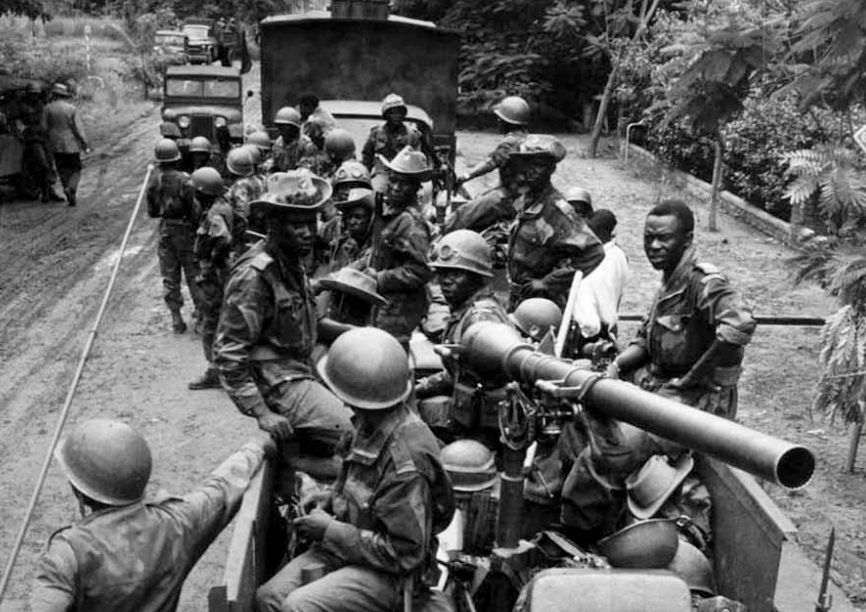
The Congo Crisis or Congo Civil War began almost immediately after independence. Within days, the national army, still led by Belgian officers, mutinied against its commanders. This triggered widespread violence, particularly targeting European civilians and prompted Belgium to deploy troops under the pretext of protecting its nationals.
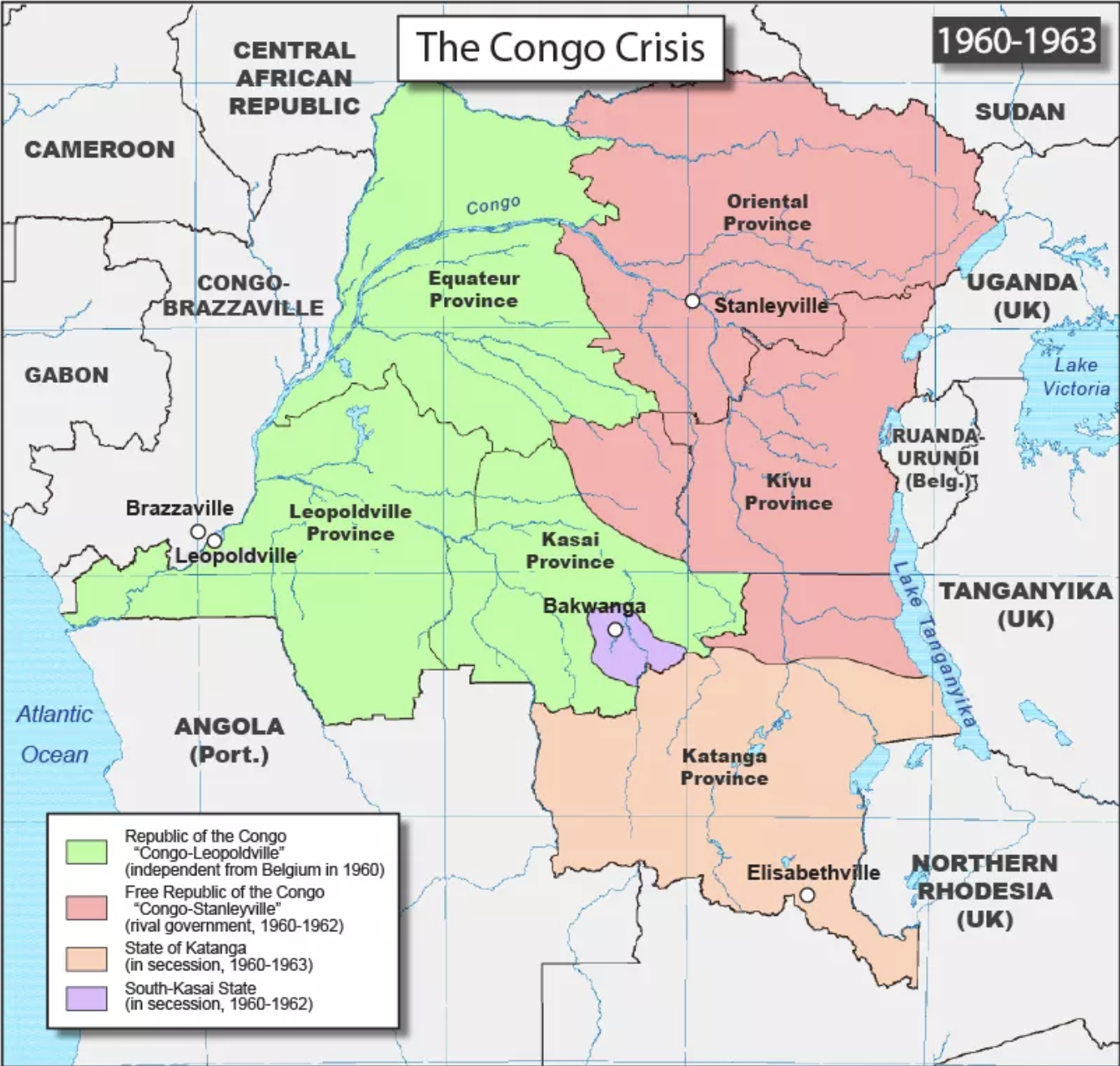
At the same time, the mineral-rich province of Katanga, led by Moïse Tshombe, declared independence with Belgian support. Shortly thereafter, South Kasai also attempted to secede. These secessionist movements were closely tied to economic interests, as foreign actors sought to retain control over valuable mining areas.
The central government, led by Prime Minister Patrice Lumumba and President Joseph Kasa-Vubu, struggled to maintain control. Lumumba sought assistance from the United Nations. In response, the UN deployed a peacekeeping mission, the United Nations Operation in the Congo (ONUC) in July 1960. However, the UN mandate was limited. It aimed to restore order and ensure the withdrawal of foreign troops but refused to intervene directly against the secessionist provinces and support the central government.
Frustrated by the UN’s reluctance to support military action against Katanga, Lumumba turned to the Soviet Union for assistance. This move alarmed western powers, especially the United States, which feared the spread of communism in Central Africa. The Congo Crisis quickly became a proxy battleground in the Cold War. The Soviet Union supported Lumumba politically and rhetorically, while the United States and Belgium covertly supported anti-Lumumba forces. Western states justified intervention as necessary to prevent a communist takeover, while the USSR accused them of neo-colonialism.
This is where our UNSC debate is taking place.
The different positions
Western Bloc
The Western bloc, led by the United States and Belgium viewed the Congo primarily through the lens of Cold War containment. Their main concern was that instability in the Congo could allow the Soviet Union to gain influence in Central Africa. The fact that Lumumba sought Soviet assistance reinforced these fears. At the same time, Western states had strong economic interests, particularly in Katanga’s mining sector. Publicly, Western states emphasized stability, anti-communism and the protection of foreign nationals. In practice, however, they often supported anti-Lumumba factions and were willing to tolerate or indirectly support secessionist movements if it aligned with their strategic and economic interests.
Eastern Bloc
The Soviet Union and its allies framed the Congo Crisis as a case of anti-colonial struggle against Western imperialism. They strongly supported Lumumba as the legitimate leader of an independent Congo and condemned Belgian intervention as neo-colonial aggression. The Soviet Union advocated for stronger and more direct support to the central Congolese government, including military assistance if necessary.
Newly Independent States
Many newly independent African and Asian states viewed the Congo Crisis as a defining moment for post-colonial sovereignty. They supported Lumumba and strongly opposed foreign intervention, particularly by former colonial powers.
Many African states also had secessionist movements in their own country and saw the Congo Crisis as a dangerous precedent. If secessionist movements supported by foreign powers were allowed to succeed, this could destabilize the entire continent. As a result, many African leaders strongly opposed Katanga’s secession and supported the territorial integrity of the Congo.
What could a resolution address
At this stage of the crisis (August 1960), the UNSC is faced with a rapidly deteriorating situation. A resolution should aim not only to stabilize the immediate conflict but also to establish a framework for long-term governance.
Firstly, the Council could clarify and potentially expand the mandate of the United Nations Operation in the Congo (ONUC). While the current mandate focuses on maintaining order and ensuring the withdrawal of foreign troops, a revised mandate could explicitly address the question of secession. The Council must decide whether UN forces should actively oppose the secessionist movement in Katanga or remain strictly neutral. The issue of foreign military presence could be addressed decisively. A resolution could call for the immediate and verifiable withdrawal of all foreign troops. Additionally, the Council could consider strengthening the role of the UN as an impartial mediator. The humanitarian situation should also not be overlooked. A resolution could call for increased humanitarian assistance, as well as guarantees for the protection of civilians. The Council may consider longer-term institutional support. This could include assistance in building administrative capacity, training security forces and supporting the development of governance structures.
Overall, the Security Council and any resolution must balance three competing priorities: respecting state sovereignty, preventing Cold War escalation and ensuring political stability within the Congo.
Questions When Researching Your Country’s Position
How did your country historically position themselves during the Cold War and decolonization?
Did your country support or oppose the involvement of the United Nations Operation in the Congo, and why?
Has my country provided material support to any side in the conflict?
How does your country interpret the legality of foreign troop presence, such as Belgian forces remaining in the Congo after independence?
How does your country define a “legitimate government” in situations of constitutional crisis, such as the conflict between Lumumba and Kasa-Vubu?
Does my country have issues with insurgency or secessions?$
What happened:
For the sake of completion here is a short overview of how things actually played out. But remember that our debate is taking place in August 1960, before any of this. The political situation within Congo escalated dramatically in September 1960 into a constitutional crisis. A power struggle between President Joseph Kasa-Vubu and Prime Minister Patrice Lumumba started, both of whom derived their authority from the newly established post-independence constitution but interpreted their powers differently. On September 5, 1960, President Kasa-Vubu announced the dismissal of Prime Minister Lumumba, accusing him of leading the country into chaos and of endangering national stability through his cooperation with the Soviet Union. Lumumba, however, rejected this dismissal as unconstitutional and in turn, declared that he was dismissing Kasa-Vubu from office. Parliament initially supported Lumumba, further complicating the situation, while foreign actors began aligning themselves with different factions. The army, under Colonel Joseph-Désiré Mobutu, soon became the decisive force. On September 14, Mobutu carried out a coup, declaring a “neutralization” of both political leaders and effectively suspending the constitutional order. He expelled all Soviet officers and arrested Lumumba. Lumumba was eventually assassinated on January 17th 1961, an event that shocked the international community and intensified the crisis. A rival government of the "Free Republic of the Congo" (red on map) was founded in the East by Lumumba supporters. It gained Soviet support but was crushed in early 1962. The UN initially pursued a policy of neutrality, refusing to take sides in internal conflicts while opposing secession. However, the mission gradually became more assertive. By 1962–1963, UN forces undertook military operations against Katanga to preserve Congolese territorial integrity. Katanga’s secession officially ended in 1963. The UN operation was one of the largest and most controversial peacekeeping missions of its time. The mission succeeded in preserving territorial integrity but failed to prevent political instability and external interference. Although the secessionist movements were defeated by 1963, instability continued. In 1965, Mobutu carried out a second coup and established a long-lasting authoritarian regime (later renaming the country Zaire). The crisis formally ended with the consolidation of Mobutu’s power, but its legacy included weakened democratic institutions, foreign interference and long-term regional instability.