Climate Migration in the South Pacific Region
Study Guide PDF: Download Here
Country Sign-up: Access Here
Introduction to the committee:
The United Nations High Commissioner for Refugees is the agency of the United Nations responsible for providing support and assistance to refugees and other forcibly displaced people. It is responsible to the General Assembly, and is led by someone who also confusingly has the title of High Commissioner for Refugees. The high commissioner is advised, monitored and reviewed by the executive committee (ExCom), which comprises member states elected by ECOSOC, the UN economic and social council. Currently, this committee comprises 110 members, widely distributed throughout the globe. We will be meeting under the auspices of the ExCom, though not necessarily perfectly adhering to its mandate, and you can basically treat your powers as being equivalent to those which you would have as the GA. Its members change every year, and will actually be changed during this topic block, but we will use the 2025/26 membership, plus a number of observers.
Climate Displacement:
The term Forcibly Displaced People (FDPs) is a widely applicable term referring to people who are forced to leave their homes as a result of war, violence, human rights abuses, or natural or human-made disasters. It encompasses refugees, who flee their home country fearing persecution on the basis of race, religion, nationality, membership of a particular social group or political opinion; internally displaced people (IDPs), who are forcibly displaced within their own country; asylum seekers; and others. In total, over 100 million people worldwide are classified as forcibly displaced, the majority of whom are internally displaced. Legal requirements for the protection of FDPs, both under national law and international agreements, vary widely.
146 nations are parties to the 1967 Protocol Relating to the Status of Refugees, which, alongside the 1951 Refugee Convention, establishes obligations concerning the protection and rights of refugees. However, these protections apply only to people who meet the specific legal definition of a refugee. There are also a number of regional agreements, such as the Cartagena Declaration in Latin America and the OAU Refugee Convention in Africa, which provide broader definitions of refugee status. Beyond these international frameworks, much of the practical protection available to FDPs is determined by national policies, which govern matters such as asylum procedures, humanitarian visas, temporary protection and assistance for internally displaced populations. Consequently, the rights and protections available to displaced people can differ significantly depending on the country in which they seek safety, as well as the circumstances of their displacement.
Climate change is an increasingly significant driver of forced displacement, both directly and indirectly. Rising sea levels, coastal erosion, flooding, tropical cyclones, droughts and other extreme weather events can render communities unsafe or uninhabitable, forcing their inhabitants to relocate. Slower-onset environmental changes, such as desertification, freshwater shortages and the loss of agricultural land, can also undermine livelihoods and contribute to displacement. Climate change can also exacerbate existing economic and political instability, contributing to conflict. People displaced by these factors are frequently referred to as climate refugees, although this term is not technically recognized under international law, and is technically inaccurate. Unlike people fleeing persecution, those displaced solely by natural disasters or environmental degradation generally do not qualify for refugee status under the 1951 Refugee Convention, even when returning to their home country is dangerous or impossible.
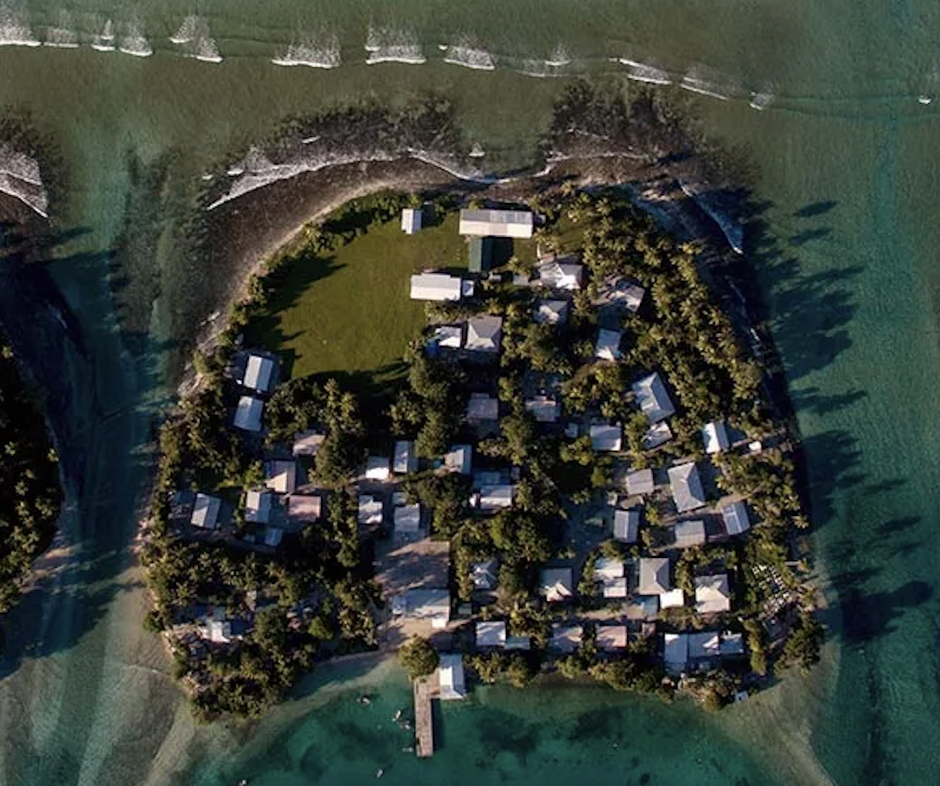
Climate-related displacement is particularly concerning for Small Island Developing States (SIDS) in the South Pacific, including Tuvalu, Kiribati and Fiji, where rising sea levels, coastal erosion and increasingly severe weather events threaten settlements, infrastructure and freshwater supplies. However, climate displacement is by no means limited to the Pacific. In Bangladesh, recurrent flooding, cyclones and coastal erosion have contributed to internal migration, while prolonged droughts and environmental degradation have threatened livelihoods across parts of sub-Saharan Africa. Similarly, severe flooding in Pakistan has displaced millions of people. So far, the majority of climate-related displacement has occurred within national borders rather than internationally, and environmental pressures frequently interact with other social, political and economic factors when influencing migration.
Despite the growing scale of climate-related displacement, there is currently no internationally recognized legal status specifically for people displaced by climate change, leaving significant gaps in their protection, particularly when crossing international borders. Nevertheless, some developments have begun to address this issue. In 2020, the UN Human Rights Committee's ruling in Teitiota v. New Zealand, concerning a Kiribati national seeking protection from the effects of rising sea levels, established that states may be prohibited from returning individuals to countries where climate-related conditions pose a sufficiently serious threat to their right to life, though Teitiota's individual claim was unsuccessful. More recently, the Australia–Tuvalu Falepili Union, signed in 2023 and entering into force in 2024, established a special migration pathway allowing Tuvaluan citizens to obtain permanent residency in Australia, allocating up to 280 places annually. The agreement aims to allow Tuvaluans to live, work and study in Australia while maintaining their connections to their homeland. The agreement aims for a legal pathway for climate-affected populations but notably does not classify its beneficiaries as forcibly displaced. Despite these actions, there is still no comprehensive international framework to protect those forced to migrate as a result of climate change, nor does any nation have an explicit legal status for those displaced by climate change.
Pacific Small Island Developing States:
Small Island Developing States (SIDS) are a group of developing countries recognized by the United Nations as facing particular social, economic and environmental vulnerabilities arising from their small size, geographical isolation and limited resources. The Pacific is home to numerous SIDS, including Fiji, Kiribati, Tuvalu, Vanuatu, Samoa and the Marshall Islands, spread across the three broad cultural and geographical regions of Melanesia, Micronesia and Polynesia. Despite their relatively small land areas, these states are distributed across an enormous expanse of the Pacific Ocean, with many comprising numerous islands and atolls separated by considerable distances. Their histories and cultures are diverse, shaped by centuries of maritime navigation, trade and settlement, as well as more recent experiences of European colonialism and independence. The ancestral lands, oceans and communities play a central role in the identities, traditions and livelihoods of many pacific island societies.
Pacific SIDS are among the countries most vulnerable to the effects of climate change, despite having contributed comparatively little to global greenhouse gas emissions. Rising sea levels pose a particularly serious threat to low-lying atoll nations such as Tuvalu, Kiribati and the Marshall Islands, where much of the population lives only a few meters above sea level. Coastal erosion, increasingly severe tropical cyclones, and changing rainfall patterns also threaten the homes and livelihoods of many communities in such nations. These challenges are compounded by the limited land area and economic resources available to many island states, restricting their capacity to adapt or relocate affected communities internally. The threat of forced relocation also poses challenges beyond the immediate loss of homes and property. It can threaten traditional practices, social structures, languages and cultural identity. In extreme circumstances, the prospect of entire populations being forced to migrate internationally also raises unprecedented questions concerning national sovereignty, citizenship, and the continued existence of states whose territories may become uninhabitable.
In response to these threats, Pacific SIDS have played a prominent role in international climate negotiations, advocating for stronger emissions reductions, increased climate financing and greater recognition of their particular vulnerabilities.They were instrumental in pushing for the inclusion of the goal of limiting global warming to 1.5°C above pre-industrial levels in the 2015 Paris Agreement. Alongside their international advocacy, these states have pursued domestic adaptation measures, including coastal defences, land reclamation, improved disaster preparedness and, where necessary, the planned relocation of vulnerable communities. Increasing attention has also been given to protecting the rights of those displaced by climate change. In 2023, the members Pacific Islands Forum, an intergovernmental organization of countries in the south pacific, endorsed the Pacific Regional Framework on Climate Mobility, which seeks to minimize forced displacement while ensuring that migration and relocation, when unavoidable, occur safely and with dignity. That same year, Forum members adopted the Declaration on the Continuity of Statehood and the Protection of Persons in the Face of Climate Change-Related Sea-Level Rise, affirming that their sovereignty and statehood should continue regardless of territorial changes caused by rising sea levels, and committing to protecting affected populations. These initiatives both show a strong preference for pacific populations remaining in their current homes, but also prepare for a worst case scenario or requiring significant resettlement as a result of climate change, something for which legal standards are not currently in place.
Actions which could be Taken:
Solving the general problem of the Climate Crisis is beyond the scope of this committee, which will focus on addressing legal and humanitarian issues related to climate migration. A resolution could recommend increased international funding for climate adaptation, disaster preparedness and planned relocation. It could also encourage greater cooperation between Pacific states, neighboring countries and relevant UN agencies, particularly UNHCR and IOM, to provide assistance to displaced populations.
A particularly important area for consideration is the development of stronger legal protections for climate-displaced people. You could explore the possibility of establishing an internationally recognized legal status for such individuals, expanding existing protection frameworks, or encouraging bilateral and regional migration agreements similar to the Australia–Tuvalu Falepili Union. The committee could also recommend measures to protect the citizenship, sovereignty and cultural rights of populations whose territories become uninhabitable. However, remain aware of the committee's limited authority: ExCom cannot independently impose binding international obligations, amend existing treaties or compel states to accept displaced populations. Instead, its role is primarily to make recommendations, encourage international cooperation and propose frameworks which member states may choose to adopt.
Key Questions when researching your country’s position:
Has my country taken an explicit stance on the protection of people displaced by Climate Change in the South Pacific?
How seriously is my country affected by climate change, and has this or is this likely to result in significant displacement? (Particularly if your country is located in the south pacific)
Is my country a party to agreements such as the 1967 Protocol Relating to the Status of Refugees, or other regional agreements on forced displacement?
What is my country’s stance on migration and asylum in general?
Who are my country’s significant allies?
Questions a resolution should answer:
What measures should be taken to protect people displaced by climate change in the South Pacific?
What sort of humanitarian support might be provided to assist the situation?
How could legal protections be adopted to protect people displaced by climate change?
What status might be adopted for countries whose territories have become uninhabitable?
Recommended Countries:
Australia
China
France
India
Kiribati
Marshall Islands
Micronesia
New Zealand
Naoero
Papua New Guinea
Solomon Islands
Tuvalu
United Kingdom of Great Britain and Northern Ireland
United States of America
Vanuatu